Gokyo Kalapathar Trek
Gokyo Kalapathar Trek Overview
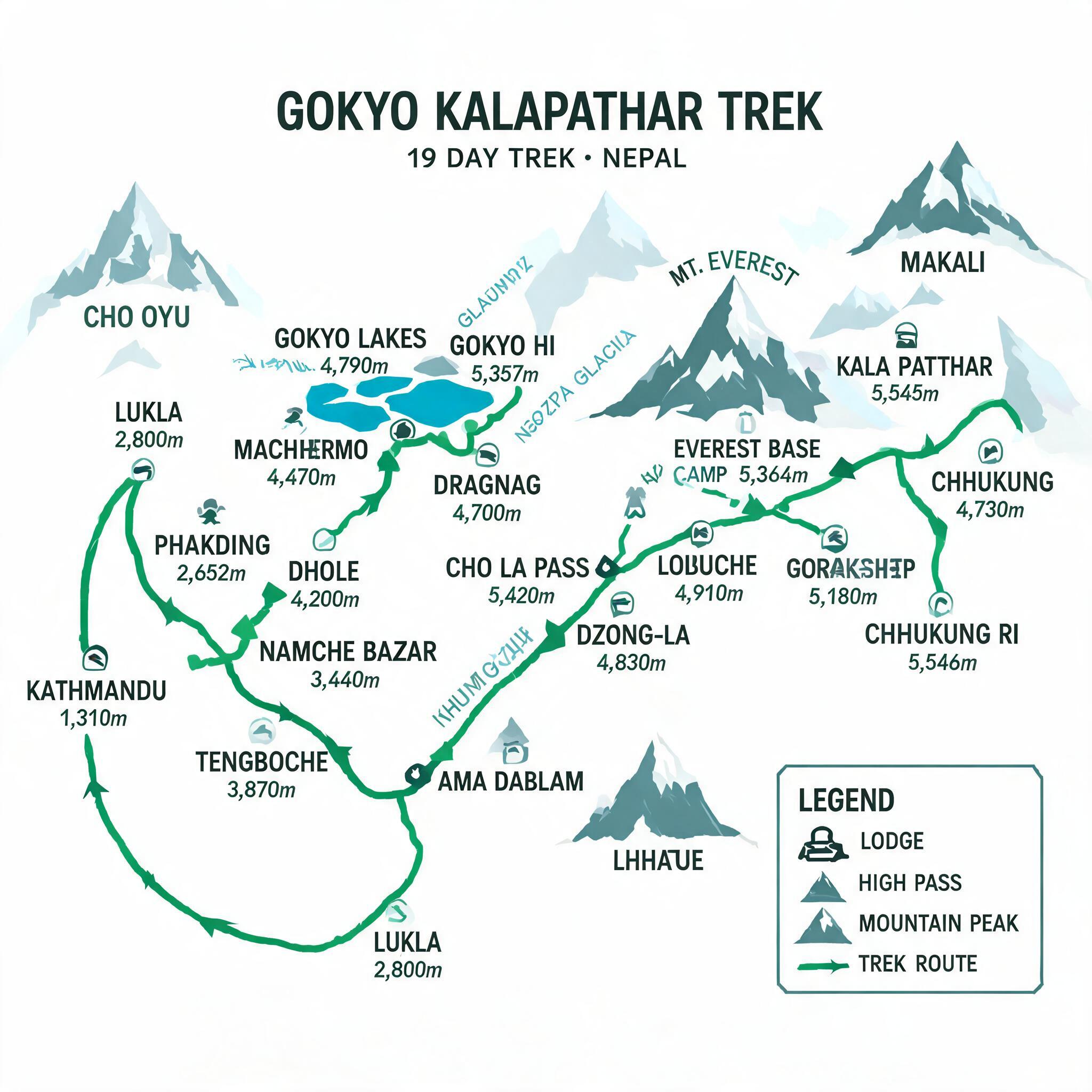
The Gokyo Kalapathar Trek is an adventurous and comprehensive Himalayan journey that masterfully combines the serene beauty of the Gokyo Valleys turquoise lakes, the challenge of crossing the high Cho La Pass, and the iconic thrill of reaching Everest Base Camp and Kala Patthar. This trek is ideal for experienced trekkers seeking a less crowded yet highly rewarding alternative to the classic Everest Base Camp route.
The journey begins with a thrilling flight to Lukla, followed by the classic trek through Sherpa villages like Phakding and the vibrant hub of Namche Bazaar. After acclimatization, the route diverges from the main trail, ascending into the pristine Gokyo Valley. Here, you'll be captivated by the stunning series of glacial lakes, offering breathtaking reflections of Cho Oyu and other Himalayan giants.
The trek's most challenging and exciting day is crossing the legendary Cho La Pass (5,420m), a high mountain pass linking the Gokyo Valley to the main Everest Base Camp trail. This demanding but rewarding crossing offers unparalleled views. The journey then continues through Lobuche and Gorakshep, culminating in an early morning ascent to Kala Patthar (5,545m) for the world's best sunrise view of Mount Everest, before visiting the base camp itself.
The trek also explores the eastern Everest region, including Chhukung and a rewarding hike to Chhukung Ri. The descent back through Tengboche, with its famous monastery, completes this unforgettable high-altitude adventure, blending remote landscapes, cultural richness, and legendary Himalayan viewpoints.
Things That You Need to Know
Difficulty Level
Why Longer and Less Crowded Than Standard EBC — 19 days combining Gokyo Valley, Cho La Pass, and Kala Patthar in one continuous route.
Trail Comparison to Standard EBC — Adds a technical glacier pass crossing and a full valley de tour that the classic EBC route skips entirely.
Fitness Requirements
Prior High-Altitude Experience Recommended — Given the technical demands of Cho La Pass.
Preparation Tips
Crampon Requirement — Season-Dependent — Needed on the glacier crossing depending on the time of year.
Insurance Coverage Minimum (6,000m Evacuation) — Must cover trekking altitude and helicopter rescue.
Equipment List
Cold-Weather Gear for High Passes — Down jacket, four-season sleeping bag, thermal layers for nights above 5,000m.
Gear Needed for the Glacier Crossing — Sturdy boots, trekking poles, and crampons if conditions require them at Cho La.
altitude Sickness Risk Zone — Highest around the Cho La Pass and Kala Patthar stretch.
Safety Measures
Guide-Led Glacier Crossing — Cho La Pass requires experienced guide supervision due to shifting ice conditions.
Permits Required
Sagarmatha National Park Entry Permit
TIMS Card Requirement
Cultural Etiquette / Local Customs
Sherpa Village Customs Along the Route — Modest dress and respectful conduct in monasteries encountered en route.
Itinerary highlights (Days 1–19)
Gokyo Ri Panorama (5,357m) — Everest, Makalu, Cho Oyu, and Ngozumpa Glacier views.
Best Photography Time — Sunrise, before clouds build later in the day.
Crossing Cho La Pass (5,420m) — Glacier and moraine terrain, the trek's hardest single day.
Chhukung Ri Viewpoint (5,546m) — Optional side hike with Ama Dablam, Lhotse, and Makalu views.
Confirm With Guide Before Attempting — Optional and weather-dependent; confirm on the day.
Highlights
Detailed Itinerary
Arrival in Kathmandu
Arrival at Kathmandu airport (1,310m). Welcome by Global Nepal Treks member and direct transfer to hotel on Bed & Breakfast plan.
Fly to Lukla & Trek to Phakding
Early morning scenic flight to Lukla (2,800m). Begin trek to Phakding (2,652m) for approx. 3 hours, traversing scenic trails. Overnight at a lodge.
Trek to Namche Bazaar
Trek from Phakding to Namche Bazaar (3,440m). The trail winds through forests, crosses suspension bridges, and offers first views of Everest. Approx. 5 hours. Overnight in Namche.
Acclimatization Day in Namche
Rest and acclimatization day. Short hike to Everest View Point for panoramic views of Everest and surrounding peaks. Explore Namche Bazaar. Overnight in Namche.
Trek to Dhole
Trek from Namche Bazaar to Dhole (4,200m). The trail ascends through alpine landscapes, past grazing yaks. Approx. 5 hours. Overnight at a lodge.
Trek to Machhermo
Trek from Dhole to Machhermo (4,470m). Approx. 4 hours through diverse terrain with stunning mountain vistas. Overnight at a lodge.
Trek to Gokyo Lake
Trek from Machhermo to Gokyo Lake (4,790m). Approx. 5 hours, rewarded with breathtaking views of the turquoise lakes and surrounding peaks like Cho Oyu. Overnight at a lodge.
Explore Gokyo Valley & Gokyo Ri
Explore the Gokyo Valley. Optional early morning hike to Gokyo Ri (5,357m) for spectacular panoramic views of Everest, Makalu, and Cho Oyu. Overnight in Gokyo.
Trek to Dragnag
Trek from Gokyo to Dragnag (4,700m). Approx. 4 hours, moving closer to the base of Cho La Pass. Overnight at a lodge.
Cross Cho La Pass to Dzong-La
**Challenging day.** Early start to cross the legendary Cho La Pass (5,420m). Trek over glaciers and steep terrain to Dzong-La (4,830m). A demanding but incredibly rewarding 7-8 hour day. Overnight at a lodge.
Trek to Lobuche
Trek from Dzong-La to Lobuche (4,910m). Approx. 4 hours, with stunning views of towering peaks. Overnight at a lodge.
Trek to Gorakshep & Everest Base Camp
Trek from Lobuche to Gorakshep (5,180m). Continue to Everest Base Camp (5,364m) to witness the Khumbu Glacier and Icefall. Return to Gorakshep for the night. A long 7-8 hour day.
Kala Patthar Sunrise & Trek to Dzong-La
Pre-dawn hike to Kala Patthar (5,545m) for an unforgettable sunrise over Everest. Return for breakfast, then trek back to Dzong-La (4,830m). Overnight at a lodge.
Trek to Chhukung
Trek from Dzong-La to Chhukung (4,730m) via the Imja Khola valley. Approx. 4-5 hours. Overnight at a lodge.
Rest Day & Chhukung Ri Hike
Rest day in Chhukung. Optional hike to Chhukung Ri (5,546m) for incredible views of Ama Dablam, Lhotse, and Makalu. Overnight in Chhukung.
Trek to Tengboche
Trek from Chhukung back to Tengboche (3,870m), passing through Pangboche and descending through rhododendron forests. Approx. 5-6 hours. Visit the famous monastery.
Trek to Namche Bazaar
Trek from Tengboche back to Namche Bazaar (3,440m) through beautiful forests. Approx. 5 hours. Overnight in Namche.
Trek to Lukla
Final day of trekking from Namche Bazaar back to Lukla (2,860m). Descend through Phakding. Approx. 6-7 hours. Celebrate in Lukla. Overnight at a lodge.
Fly back to Kathmandu
Morning scenic flight back to Kathmandu. Transfer to your hotel. Free time to explore. Farewell dinner in the evening.
Inclusions & Exclusions
Included
- Airport pick up & drops by private transport
- Domestic flight from Kathmandu to Lukla and return
- All ground transportation as per the itinerary
- 3 meals per day during the trek (Breakfast, Lunch, Dinner) including Tea or coffee
- Accommodation in tea houses/lodges during the trek
- 3 Nights hotel accommodation in Kathmandu with breakfast
- An experienced English-speaking trekking guide
- Necessary porter (1 porter for 2 guests)
- All Government local taxes
- Sagarmatha National Park entry fees
- Khumbu Pasang Lhamu Rural Municipality Permit
- TIMS (Trekkers Information Management System) card
- First Aid kit
- Guide and porter salary
- Guide and porter insurance during the trekking
- Farewell dinner in Kathmandu
Excluded
- Trekking equipment and any personal expenses (alcoholic beverages, phone usage, laundry)
- Emergency Rescue and Travel Insurance (mandatory, highly recommended)
- Trip Cancellation cost due to accident, health, loss, theft, or damage
- Lunch and dinner in Kathmandu
- Tips for guides, porters, and other service staff
Essential Information
Trip Code
GNT-GKT
Trip Type
Restricted-region-adjacent high-altitude trek (Gokyo Valley + Cho La Pass + Everest region)
Accommodation
Teahouses/lodges throughout the trek; 2–3 star hotel in Kathmandu pre/post-trek
Meals
Full board (breakfast, lunch, dinner) during trek; breakfast only in Kathmandu
Transportation
Domestic flight Kathmandu–Lukla–Kathmandu; on-foot for the entire trekking route
Best Time to Visit
Spring (March–May) and Autumn (September–November) are the ideal seasons for the Gokyo Kalapathar Trek. These months offer the clearest skies, most stable weather, and the safest conditions for crossing the high-altitude Cho La Pass (5,420m). Winter (December–February) is possible but extremely cold; monsoon (June–August) brings heavy rain, poor visibility, and unsafe pass conditions. October and November are peak months for crystal-clear Himalayan panoramas from Kala Patthar and Gokyo Ri.
Difficulty Level
Rated Challenging — one of the most demanding treks in the Everest region. The 19-day itinerary involves long daily trekking hours (up to 7–8 hours on peak days), sustained high altitudes above 5,000m, and a glacier crossing at Cho La Pass (5,420m). The Cho La Pass crossing (Day 10) is the single hardest day — involving steep glacial terrain, ice, and moraine that may require crampons. Longer, more remote, and less crowded than the classic Everest Base Camp trek, making it more physically and mentally demanding.
Fitness Requirements
Preparation Tips
Equipment List
Health Considerations
Safety Measures
Permits Required
Permit Cost: $50.00
Cultural Etiquette
Local Customs
Route Map
Frequently Asked Questions
What is the Everest Gokyo Kalapathar Trek?
The Everest Gokyo Kalapathar Trek is a comprehensive and adventurous trekking route in the Everest region. It combines the stunning turquoise Gokyo Lakes, the challenging Cho La Pass, Everest Base Camp, and the iconic sunrise viewpoint of Kala Patthar, offering a complete Himalayan experience away from the main crowds.
How long does the trek take?
This comprehensive trek typically takes around 18-20 days. Our detailed 19-day itinerary allows for proper acclimatization, exploration of the Gokyo Valley, crossing the Cho La Pass, and reaching the high points of EBC and Kala Patthar.
What is the difficulty level of the trek?
The trek is considered challenging. It requires excellent physical fitness, stamina, and ideally some previous high-altitude trekking experience due to the long duration, high altitudes, and the demanding crossing of Cho La Pass (5,420m).
What is the best time for this trek?
The best time is during Spring (March to May) and Autumn (September to November). These seasons offer the most stable weather, clearest skies, and safest conditions for crossing the high Cho La Pass.
What permits are required for the trek?
Trekkers need the Sagarmatha National Park Entry Permit, the Khumbu Pasang Lhamu Rural Municipality Permit, and a TIMS card. All these are included in our package.
What is the accommodation like during the trek?
Accommodation is primarily in comfortable tea houses or lodges found in all villages along the route. They provide basic amenities, a bed, blankets, and meals. The package also includes hotel stays in Kathmandu.
What are the major highlights of this trek?
Key highlights include the turquoise Gokyo Lakes, the challenging Cho La Pass crossing, Everest Base Camp, sunrise from Kala Patthar, views from Gokyo Ri and Chhukung Ri, the Sherpa culture, and the famous Tengboche Monastery.
Is it necessary to hire a guide and porter?
While not mandatory for experienced trekkers familiar with the region, hiring a guide and porter is highly recommended for safety, navigation, support in crossing the pass, and gaining deeper cultural insights. Our package includes both.
What is the altitude sickness risk, and how can it be prevented?
Altitude sickness is a significant risk on this trek due to the high altitudes. Prevention includes proper acclimatization (built into our itinerary), staying hydrated, ascending gradually, and listening to your body. Your guide will monitor everyone.
What should I pack for the Gokyo Kalapathar Trek?
Essential items include sturdy trekking boots, a high-quality sleeping bag, multiple warm layers (thermal, fleece, down jacket), a waterproof outer shell, trekking poles (essential for Cho La), headlamp, water bottles, high-SPF sunscreen, sunglasses, a hat, and a personal first aid kit.
Is travel insurance necessary for this trek?
Yes, comprehensive travel insurance is absolutely essential for this challenging trek. It must cover trekking at altitudes up to 5,600m, including emergency helicopter evacuation, medical expenses, and trip cancellation.
What is the Cho La Pass crossing like?
Crossing Cho La Pass (5,420m) is the most challenging day of the trek. It involves a steep climb over a glacier with moraine and ice, often requiring careful footing. It is physically demanding but offers spectacular and unforgettable views. Proper gear and acclimatization are crucial.
Can I see Mount Everest from Gokyo Ri?
Yes, Gokyo Ri (5,357m) offers a spectacular and unique panoramic view of four 8,000m peaks: Everest, Lhotse, Makalu, and Cho Oyu, along with the massive Ngozumpa Glacier and the turquoise Gokyo Lakes.
How does this trek compare to the classic Everest Base Camp trek?
This trek is longer, more challenging, and less crowded. It offers the added beauty and solitude of the Gokyo Valley and the thrill of crossing Cho La Pass, providing a more comprehensive and adventurous experience of the Everest region.
What are the Gokyo Lakes?
The Gokyo Lakes are a series of stunning, sacred, turquoise-colored oligotrophic lakes in the Everest region. They are among the highest freshwater lake systems in the world and are a breathtakingly beautiful highlight of the trek.