Introduction
The Everest Monastery Yoga Trek is Nepal's most unique spiritual adventure. It combines the world-famous Everest Base Camp trekking route with daily yoga sessions and visits to the most sacred Buddhist monasteries in the Himalayas — Tengboche, Pangboche, Thyangboche, and Namche's ancient gompa.
This is not just a trek. It is a complete mind-body-spirit experience at altitudes up to 5,545m. Every morning begins with sunrise yoga overlooking Ama Dablam and Everest. Every evening ends with monastery visits, butter lamp ceremonies, and Buddhist chanting from Sherpa monks.
After 15+ years guiding trekkers through the Khumbu Valley, Global Nepal Treks designed this itinerary specifically for travellers who want more than just reaching Base Camp — they want transformation.
Quick facts:
Duration: 14 days
Maximum altitude: 5,545m (Kala Patthar)
Difficulty: Moderate to Challenging
Price: From $1,750 per person
Group size: 2–10 people
Yoga sessions: Daily — morning and evening
Monasteries visited: 6 sacred sites
Includes: Licensed guide, yoga instructor, porter, all meals, accommodation, permits, Lukla flights
What Makes This Trek Unique
Most EBC trekkers focus entirely on the physical destination — reaching Base Camp at 5,357m. The Everest Monastery Yoga Trek adds two dimensions that most trekkers completely miss:
1. Daily yoga practice at altitude
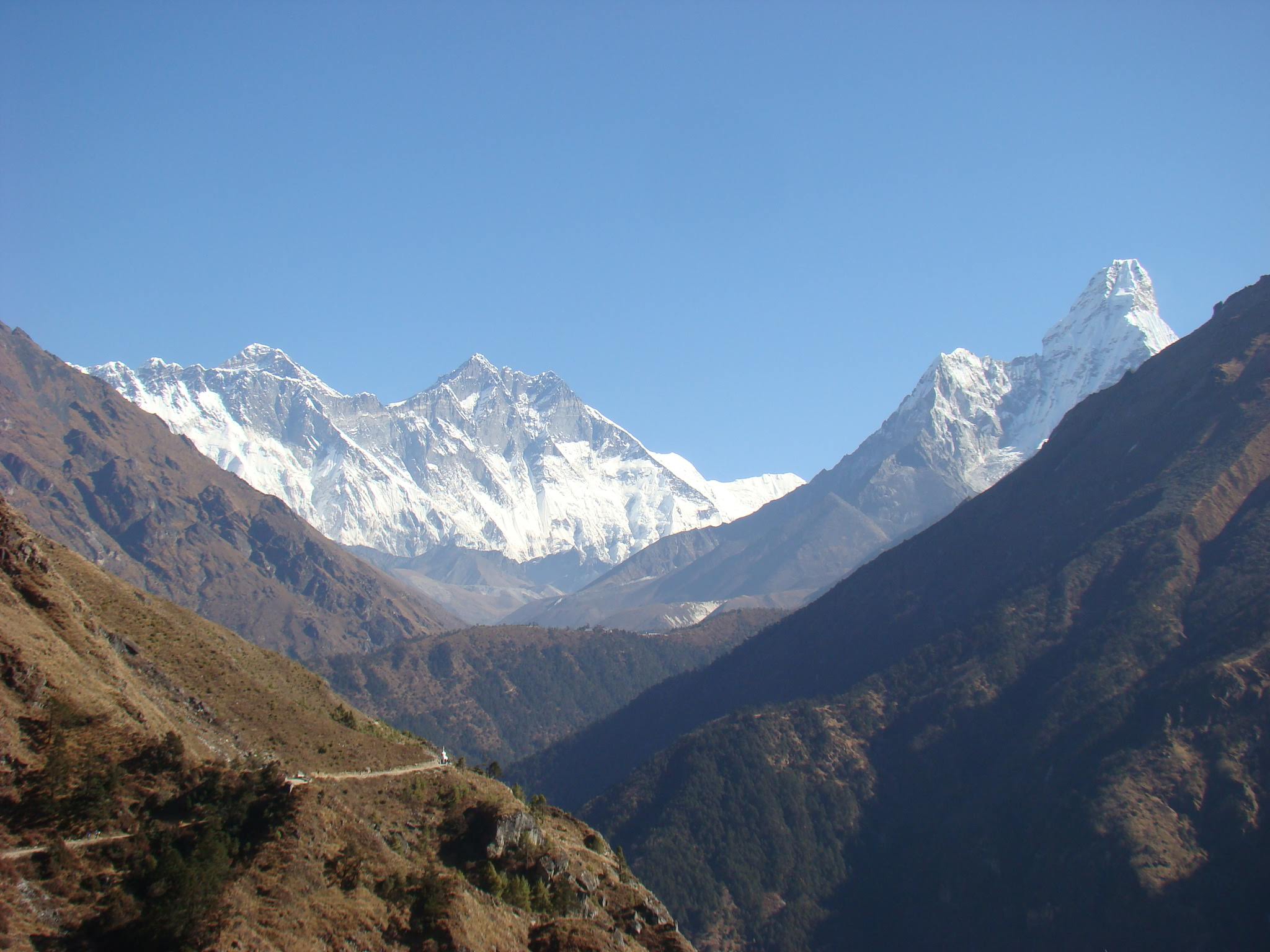
Yoga at 3,000–4,500m is a fundamentally different experience from yoga at sea level. Thinner air demands deeper, more conscious breathing. Each sunrise yoga session — with Everest, Lhotse, and Ama Dablam visible on the horizon — produces a state of awareness that is impossible to replicate anywhere else on earth.
Our certified yoga instructor accompanies the group throughout. Sessions are adapted to altitude — gentle and breath-focused at higher elevations, more active and energising at lower camps.
2. Sacred monastery immersion
The Khumbu Valley contains the greatest concentration of Tibetan Buddhist monasteries outside Tibet. Most EBC trekkers walk past them without understanding their significance. On this trek, your guide provides deep cultural context at each monastery — the founding stories, the Buddhist philosophy, the Sherpa traditions that have shaped life in this valley for 500 years.
Complete 14-Day Itinerary
Day 1 — Arrive Kathmandu (1,400m)
Arrive at Tribhuvan International Airport. Transfer to a hotel in Thamel. Evening welcome dinner and trek briefing. Meet your guide, yoga instructor, and porter team.
Yoga session: Gentle evening restorative yoga — jet lag recovery and breathwork introduction. 60 minutes.
Day 2 — Kathmandu Sightseeing — Boudhanath and Swayambhunath
Morning visit to Boudhanath Stupa — one of the largest Buddhist stupas in the world and a UNESCO World Heritage Site. Afternoon visit to Swayambhunath (Monkey Temple) with panoramic Kathmandu Valley views.
Yoga session: Morning meditation at Boudhanath. Evening pranayama (breathwork) at hotel. 90 minutes total.
Spiritual significance: Boudhanath is the spiritual heart of the Tibetan Buddhist community in Nepal. Walking the kora (circumambulation) with monks and pilgrims is your first immersion into the Buddhist world you will explore throughout the trek.
Day 3 — Fly Kathmandu → Lukla (2,860m) · Trek to Phakding (2,610m)
Early morning flight to Tenzing-Hillary Airport in Lukla — one of the world's most dramatic mountain airports. Trek 3–4 hours through the Dudh Koshi valley to Phakding tea house.
Yoga session: Evening gentle yoga and meditation at tea house. 45 minutes.
Monastery: Chaurikharka Monastery — small but ancient — visited en route to Phakding.
Day 4 — Phakding → Namche Bazaar (3,440m)
Trek 5–6 hours through pine forests, suspension bridges over the Dudh Koshi River, and the Sagarmatha National Park checkpoint. Steep final ascent to Namche Bazaar — the gateway to the high Himalayas.
Yoga session: Morning sunrise yoga with first Himalayan panorama views. Evening restoration yoga. 90 minutes total.
Monastery: Namche Gompa — the oldest monastery in Namche Bazaar. Attend evening prayer ceremonies with resident monks if timing allows.
Day 5 — Namche Bazaar Acclimatization Day (3,440m)
Full rest and acclimatization day in Namche. Morning hike to Everest View Hotel (3,880m) for your first view of Everest, Lhotse, and Ama Dablam. Afternoon visit to Sherpa Culture Museum and Hillary School.
Yoga session: Sunrise yoga at Everest View Hotel (3,880m) — your highest yoga practice so far, with Everest directly in view. 75 minutes. Evening meditation and yoga nidra (yogic sleep). 60 minutes.
Cultural immersion: Sherpa Culture Museum covers 500 years of Khumbu Valley history, the role of Buddhism in Sherpa life, and the mountaineering legacy of the world's greatest high-altitude guides.
Day 6 — Namche → Tengboche (3,867m)
Trek 5–6 hours through rhododendron and birch forests with constant Ama Dablam views. Arrive at Tengboche — home to the most famous and beautiful monastery in the Everest region.
Yoga session: Sunrise yoga at Tengboche monastery courtyard with Ama Dablam directly ahead — one of the most powerful yoga settings on earth. 90 minutes.
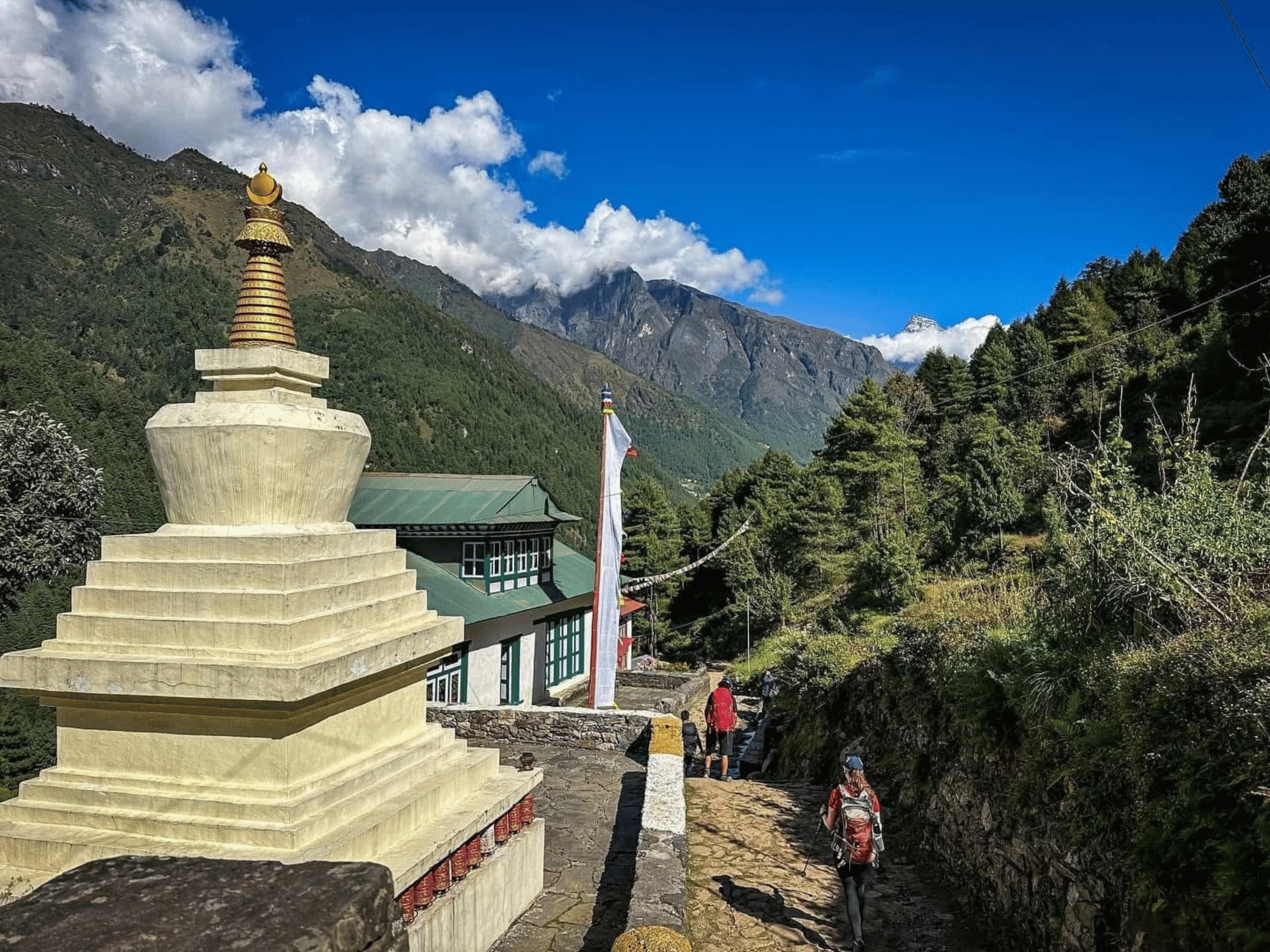
Monastery — HIGHLIGHT: Tengboche Monastery (Thyangboche Gompa) is the spiritual centre of the Khumbu Valley. Founded in 1916 and rebuilt after a 1989 fire, it houses resident monks year-round. Evening puja (prayer ceremony) with butter lamps, Buddhist chanting, and traditional instruments. This is one of the most moving spiritual experiences available to trekkers anywhere in Nepal.
Day 7 — Tengboche → Dingboche (4,410m)
Trek 5–6 hours descending to Pangboche then climbing to Dingboche — a dramatic open valley with views of Lhotse, Makalu, and Island Peak.
Yoga session: Morning yoga at Tengboche before departure — final session at this sacred site. Evening restorative yoga adapted for 4,410m altitude — gentle, breath-focused, 45 minutes.
Monastery: Pangboche Monastery — the oldest monastery in the Khumbu Valley, founded in the 17th century. Contains what Sherpa tradition claims are the skull and hand of a Yeti — an intriguing piece of Khumbu folklore regardless of your beliefs.
Day 8 — Dingboche Acclimatization Day (4,410m)
Second acclimatization day. Morning hike to Nangkartshang Hill (5,050m) for views of Makalu (8,463m), Lhotse (8,516m), Ama Dablam (6,812m), and Island Peak (6,189m).
Yoga session: Sunrise yoga at Nangkartshang Hill (5,050m) — your highest yoga practice of the trek, above the clouds. 60 minutes. This is a genuinely transcendent experience — many trekkers describe this as the most powerful yoga session of their lives. Evening meditation and yoga nidra. 60 minutes.
Day 9 — Dingboche → Lobuche (4,940m)
Trek 4–5 hours past the Thukla memorial chortens — stone monuments to climbers who died on Everest. A profoundly moving passage. Arrive at Lobuche with views of Pumori and Nuptse.
Yoga session: Morning gentle yoga and breathwork — altitude adaptation. 45 minutes. Evening meditation at the Thukla memorials — a powerful moment to reflect on impermanence, a core Buddhist teaching.
Day 10 — Lobuche → Everest Base Camp (5,357m) → Gorak Shep (5,140m)
The most iconic day of the trek. Trek 3–4 hours to Everest Base Camp — the starting point of all Everest summit attempts. Stand at the foot of the world's highest mountain and look up at the Khumbu Icefall. Return to Gorak Shep overnight.
Yoga session: Brief seated meditation at Everest Base Camp (5,357m). 20 minutes — altitude and exhaustion make a full session impractical here. The meditation itself at this altitude and location is profoundly powerful.
Day 11 — Kala Patthar (5,545m) → Descend to Pheriche (4,371m)
Pre-dawn start (4:30 AM) to summit Kala Patthar at 5,545m for the most famous Everest sunrise view on earth. Watching the first golden light hit Everest's summit pyramid from 8,849m above — one of the most extraordinary experiences a human being can have. Descend to Pheriche.
Yoga session: Sunrise yoga at Kala Patthar summit (5,545m) — your highest yoga practice, at the highest yoga session available on any commercial trekking route in the world. 30 minutes of breathwork and sun salutations as the sun rises over Everest. Many trekkers report this as a life-changing moment.
Day 12 — Pheriche → Namche Bazaar (3,440m)
Long descent — 6–7 hours. Your body recovers as oxygen levels increase with every step down. Arrive at Namche for the final night in the Khumbu.
Yoga session: Celebration yoga — energising vinyasa flow. 60 minutes. The contrast between this session and the breathless 5,545m sessions above shows how far you have come.
Day 13 — Namche Bazaar → Lukla (2,860m)
Final trekking day. Descent through familiar landscapes — rhododendron forests, suspension bridges, Dudh Koshi Valley. Arrive Lukla for celebration dinner with your guide and porter team.
Yoga session: Closing ceremony yoga and meditation. 90 minutes. Reflect on 14 days of practice, transformation, and Himalayan immersion. Exchange gratitude with your Sherpa team.
Day 14 — Fly Lukla → Kathmandu · Departure
Early morning flight back to Kathmandu. Airport transfer. Free time for last-minute shopping in Thamel. Evening farewell dinner. Transfer to international airport for departure.
6 Sacred Monasteries You Will Visit
Monastery | Altitude | Founded | Highlight |
Boudhanath Stupa, Kathmandu | 1,400m | 5th century | Largest stupa in Nepal — UNESCO site |
Swayambhunath, Kathmandu | 1,400m | 5th century | Ancient hilltop stupa — panoramic city views |
Chaurikharka Monastery | 2,700m | 16th century | First Khumbu monastery en route |
Namche Gompa | 3,440m | 18th century | Oldest Namche monastery — evening puja |
Tengboche Monastery | 3,867m | 1916 | Most famous Khumbu monastery — essential |
Pangboche Monastery | 3,930m | 17th century | Oldest in Khumbu — Yeti skull legend |
Daily Yoga Schedule
Time | Session | Duration | Type |
6:00 AM | Sunrise yoga | 60–90 mins | Vinyasa or Hatha depending on altitude |
7:30 AM | Breakfast | — | — |
8:30 AM | Trek begins | — | — |
5:30 PM | Arrival at tea house | — | — |
6:00 PM | Evening yoga | 45–60 mins | Restorative / Yin / Yoga Nidra |
7:30 PM | Dinner | — | — |
Altitude adaptation: Above 4,500m all yoga sessions become gentler and more breath-focused. Our yoga instructor adapts every session to altitude and group energy. Nobody is pushed beyond their comfort — the mountain itself provides enough challenge.
Cost — Everest Monastery Yoga Trek 2026
Global Nepal Treks package — from $1,750 per person
What is included
✅ 14-day complete itinerary
✅ Licensed NTB Sherpa trekking guide
✅ Certified yoga instructor throughout
✅ Porter (1 per 2 trekkers)
✅ All accommodation — 3-star hotel Kathmandu + tea houses on trail
✅ All meals — breakfast, lunch, dinner every day
✅ All permits — Sagarmatha National Park + TIMS card
✅ Domestic flights — Kathmandu to Lukla return
✅ Airport transfers both ways
✅ Yoga mats provided
✅ Monastery entry fees
✅ 24/7 emergency support from Kathmandu office
What is not included
❌ International flights to Kathmandu
❌ Nepal visa ($30–50)
❌ Travel insurance — mandatory, must cover helicopter evacuation to 6,000m
❌ Tips for guide, yoga instructor, and porter ($300–450 recommended for 14 days)
❌ Personal spending — hot showers, Wi-Fi, charging, snacks
❌ Personal trekking and yoga clothing
Price by group size
Group size | Price per person |
1 person (private) | $2,100 |
2–3 people | $1,900 |
4–6 people | $1,750 |
7–10 people | $1,650 |
Difficulty and Fitness Requirements
Trek difficulty: Moderate to Challenging
Yoga difficulty: All levels welcome — beginner to advanced. Sessions are adapted to each participant's ability. No prior yoga experience required.
Physical fitness required:
Able to walk 8–14 km per day with a 7–8 kg daypack
Comfortable with 5–7 hours of walking daily for consecutive days
No cardiovascular or respiratory health conditions
Age range: 18–65 years (medical clearance recommended above 60)
Prior yoga experience: Not required. Our yoga instructor teaches all levels. Some prior experience enhances the high-altitude practice but is not necessary.
Best Time for Everest Monastery Yoga Trek 2026
Season | Months | Conditions | Yoga experience |
Spring | March–May | ✅ Best — stable, clear skies, rhododendron blooms | ✅ Sunrise yoga with flower-covered hillsides |
Monsoon | June–August | ❌ Heavy rain, poor visibility | Not recommended |
Autumn | September–November | ✅ Best — crystal clear skies, stable weather | ✅ Sharpest mountain views for yoga sessions |
Winter | December–February | 🟡 Cold but possible | Cold yoga sessions — experienced trekkers only |
Our recommendation: October for the clearest Everest views during yoga sessions. April rhododendron blooms along the trail.
What to Pack for Yoga Trek
Yoga specific items:
2 × moisture-wicking yoga leggings (merino wool recommended — warm and stretchy)
2 × moisture-wicking yoga tops (long-sleeve for high altitude sessions)
1 × yoga mat travel bag (we provide mats — bring your bag if preferred)
1 × meditation cushion (optional — tea house cushions available)
Standard EBC trekking gear: See our complete EBC Trek Packing List 2026 guide for the full trekking clothing and equipment list.
Frequently Asked Questions
Q: Do I need prior yoga experience for the Everest Monastery Yoga Trek?
No. Our certified yoga instructor teaches all levels from complete beginners to advanced practitioners. Sessions are adapted daily to the group's level and the altitude conditions. Many trekkers on this trek have never done yoga before and find the Himalayan setting the perfect place to begin.
Q: How is yoga practice different at high altitude?
Significantly different. Above 4,000m the reduced oxygen makes even gentle movement feel more intense. Breath awareness — the foundation of yoga — becomes immediately tangible because every breath requires conscious effort. Most trekkers report that high-altitude yoga produces deeper states of meditation than anything they have experienced at sea level.
Q: What yoga style is practiced on the trek?
Morning sessions focus on Hatha yoga and gentle Vinyasa flow — energising for the trekking day ahead. Evening sessions focus on Yin yoga and Restorative yoga — helping tired muscles recover. Above 4,500m all sessions become breath-focused Pranayama and seated meditation — vigorous practice is not appropriate at extreme altitude.
Q: Can I do this trek without attending all yoga sessions?
Yes. Yoga participation is encouraged but never forced. Some trekkers prefer to rest during sessions at higher altitudes and this is completely understood and respected.
Q: Is the Tengboche Monastery puja ceremony guaranteed?
The evening puja at Tengboche Monastery happens daily at approximately 3:00 PM. We time our arrival to include this ceremony. Occasionally the monastery schedules changes for festivals or ceremonies — your guide will advise of any changes.
Q: What is included in the monastery visits?
Your guide provides complete historical and spiritual context at each monastery. Entry fees are included. Butter lamp offering ceremonies are arranged at Tengboche and Pangboche. Photography is permitted in monastery courtyards — inside the main hall requires the monk's permission which your guide arranges.
Q: How large are the groups on this trek?
Maximum 10 people per group for the Everest Monastery Yoga Trek. Small groups ensure the yoga instructor can give personal attention to every participant and maintain the spiritual intimacy that makes this trek special.
Q: What if I experience altitude sickness?
Our Sherpa guide monitors every trekker's health daily using a pulse oximeter. Altitude sickness symptoms are taken very seriously. If any trekker shows concerning symptoms — descent is arranged immediately. Travel insurance covering helicopter evacuation to 6,000m is mandatory for this reason.
Why Book with Global Nepal Treks
Global Nepal Treks (Licence No. 3058) has been guiding spiritual and adventure trekkers in the Himalayas since 2008. We designed the Everest Monastery Yoga Trek specifically because we saw how many trekkers rushed past the extraordinary spiritual heritage of the Khumbu Valley without pausing to absorb it.
Our yoga instructors are certified in Hatha, Vinyasa, and Restorative yoga and have specifically trained for high-altitude practice. Our Sherpa guides are NTB licensed with first aid certification and altitude medicine training.
15+ years · 1,000+ successful treks · NMA + TAAN + NTB member
Book Everest Monastery Yoga Trek 2026
From $1,750 per person — all inclusive
Limited departures available for Spring 2026 (March–May) and Autumn 2026 (September–November). October spots are filling fast.
📧 info@globalnepaltreks.com
📞 +977-9744258519 / +977-9821274866
🌐 globalnepaltreks.com/nepal/trekking/everest-monastery-yoga-trek
Also available: Annapurna Base Camp Yoga Trek (10 days from $1,150) — contact us for details.